Imitation Pearls: What They Are Made Of and How to Spot Them
Pearls are everywhere in Indian jewellery: pearl drops on jhumkas, pearl strands on Kundan chokers, pearl borders on temple necklaces. In artificial jewellery, these are imitation pearls. They are not all the same, and knowing the types helps you judge quality.
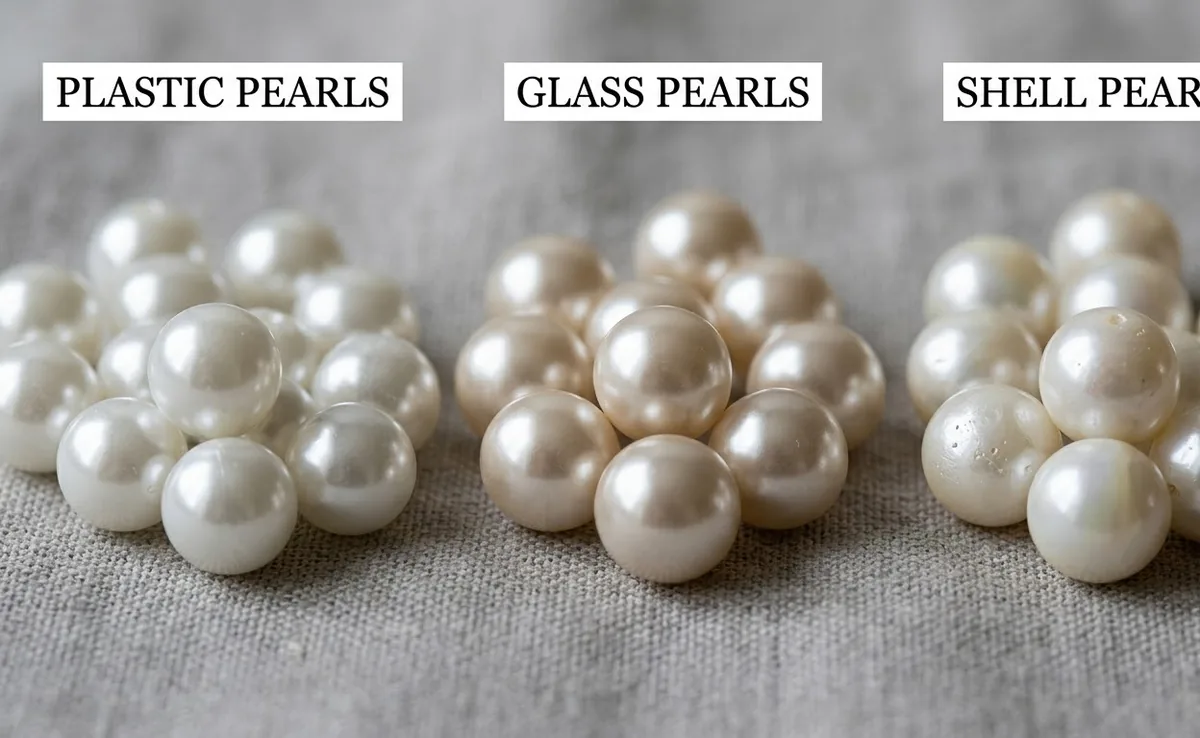
What are imitation pearls made of?
- Glass pearls: a glass bead coated with layers of pearly lacquer. Heavy, smooth and cool to touch. The best imitation pearls are glass.
- Shell pearls: a bead made from powdered or solid mother-of-pearl shell, coated for lustre. Heavy and lustrous.
- Plastic (acrylic) pearls: a plastic bead with a pearly coating. Light and cheap; the coating can peel.
How to tell fake pearls from real
- The tooth test: rub a pearl gently against the edge of your tooth. Real pearls feel slightly gritty; imitation pearls feel smooth.
- Temperature: real and glass pearls feel cool at first; plastic feels warm.
- Weight: plastic pearls are noticeably light.
- Uniformity: perfectly identical pearls are usually imitation; real pearls vary slightly.
- Drill holes: peeling coating around the hole shows an imitation.
Pearls in Indian jewellery
- Pearl drops on jhumkas and chandbalis. See Kundan chandbali earrings.
- Pearl strands on Kundan and Polki-style sets.
- Pearl borders and hangings on temple necklaces.
- Basra-style (small, irregular) pearls on traditional Hyderabadi designs.
How to clean imitation pearls that have yellowed
- Wipe after every wear with a soft dry cloth. Sweat and perfume damage the coating.
- Never soak them and never use chemicals, which strip the coating.
- Yellowing is often a sign of coating wear. Gentle wiping can remove surface grime, but a worn coating cannot be restored.
- Store flat in a soft pouch, away from sharper jewellery that can scratch the coating.
Real pearls vs imitation pearls
- Real pearls (natural or cultured) grow inside oysters or mussels. They have layers of nacre that give a deep glow, slight variations in shape and colour, and a gritty feel against the teeth.
- Imitation pearls have a man-made core with a pearly coating on the outside. They are uniform, smooth and much cheaper.
Most pearls in Indian artificial jewellery are imitation. Cultured freshwater pearls are sometimes used in higher-priced pieces.
Pearl colours in Indian jewellery
- White and cream - classic, with gold-tone jewellery.
- Pink - soft, for pastel outfits.
- Golden - warm, with antique gold.
- Green or red beads - often mixed with pearls in Kundan and temple pieces.
How to make imitation pearls last
- Put them on last and take them off first.
- Never spray perfume near them.
- Wipe them gently after every wear.
- Do not store them in plastic bags, where moisture can collect.
- Keep them away from heat and direct sunlight.
Pearl jewellery for occasions
- Weddings: pearl layers with Kundan or Polki-style sets.
- Mehendi: pastel pearl sets. Read mehendi jewellery for the bride.
- Office: small pearl studs or a single strand.
- Receptions: pearl drops on chandbalis.
Imitation pearl necklace and earrings sets
A pearl choker with matching drop earrings is one of the most versatile sets you can own. It suits sarees, lehengas and even western outfits, and it works for weddings, parties and the office. Browse Kundan chandbali earrings for pearl-drop designs.
Where do pearls come from in India?
Hyderabad is famous as India's "City of Pearls", known for its pearl trade, drilling and stringing. Many traditional pearl designs, like Basra-style strands, come from there.
Pearl jewellery for daily wear
Small pearl studs and a single strand are among the most versatile everyday pieces: they suit office wear, college and casual Indian outfits. Keep them away from perfume and wipe them after wearing. Store them flat in a soft pouch, never hanging, so the thread does not stretch.
Frequently asked questions
What is an imitation pearl?
A glass, shell or plastic bead coated to look like a natural pearl.
Which imitation pearls are best?
Glass and shell pearls are heavier and more lustrous; plastic pearls are the lightest and cheapest.
Why do fake pearls peel?
Sweat, perfume and friction wear the pearly coating off the bead.