Jadau Jewellery: The Technique Behind the Price
Jadau is a way of setting stones in which each stone is pressed into softened gold rather than held by claws. The word means "embedded". It is one of the oldest and most expensive stone-setting techniques in India, closely tied to Kundan and Polki bridal jewellery from Rajasthan and the old Mughal and Hyderabadi courts. Understanding jadau explains why some bridal pieces cost so much - and what imitation can and cannot reproduce.
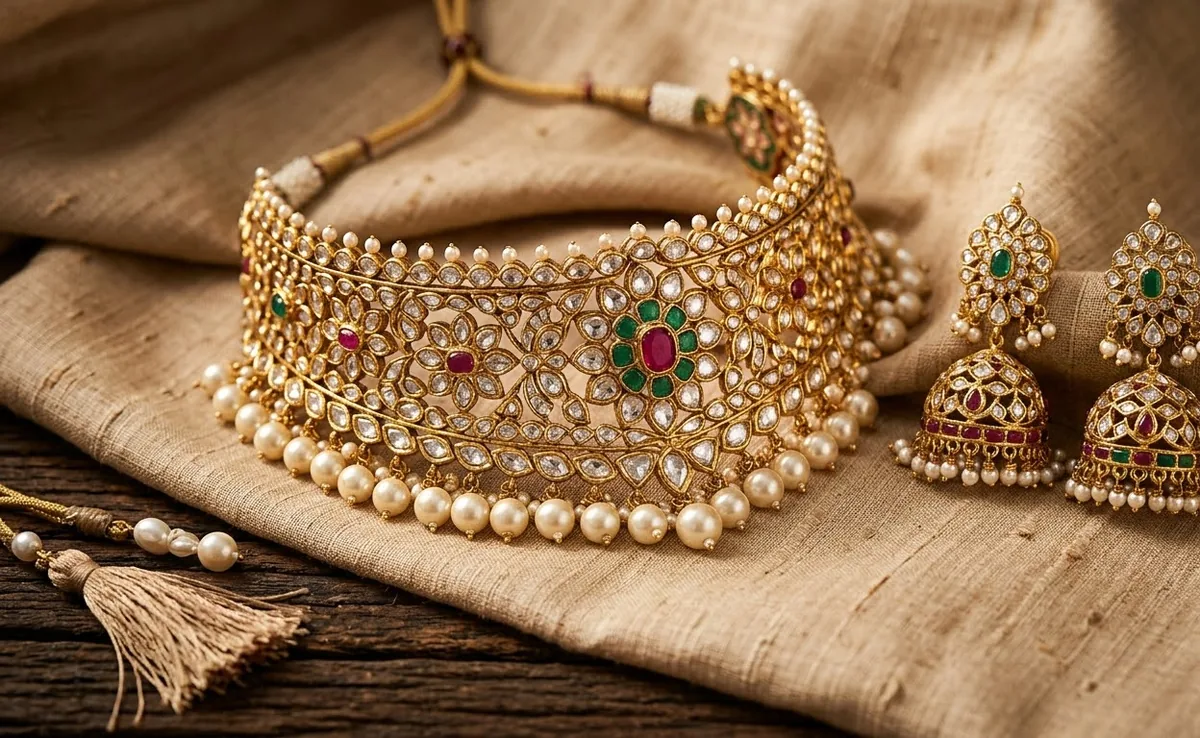
How jadau differs from a claw setting
In a claw (prong) setting, a stone sits in a metal cup and small claws are bent over its edge. Light passes through and around the stone - which is why diamonds are usually claw-set.
In jadau, the craftsman heats and softens pure gold, then pushes the stone into it, building gold up around the edges to hold it. There are no claws; the gold itself grips the stone. Under the stone a foil (kundan) is often placed to reflect light back through it. The result is a flat, smooth surface of stones framed in gold.
Why it takes so long
Jadau is slow because:
- Pure gold is needed - it is soft enough to be worked cold around a stone.
- Each stone is set by hand, one at a time, with the gold built up in layers.
- The enamelling (meenakari) on the back is often done first, and the setting must not crack it.
- Uncut stones (Polki) are irregular, so each setting is shaped individually.
A large bridal necklace can take weeks. Read meenakari explained and what is Kundan jewellery.
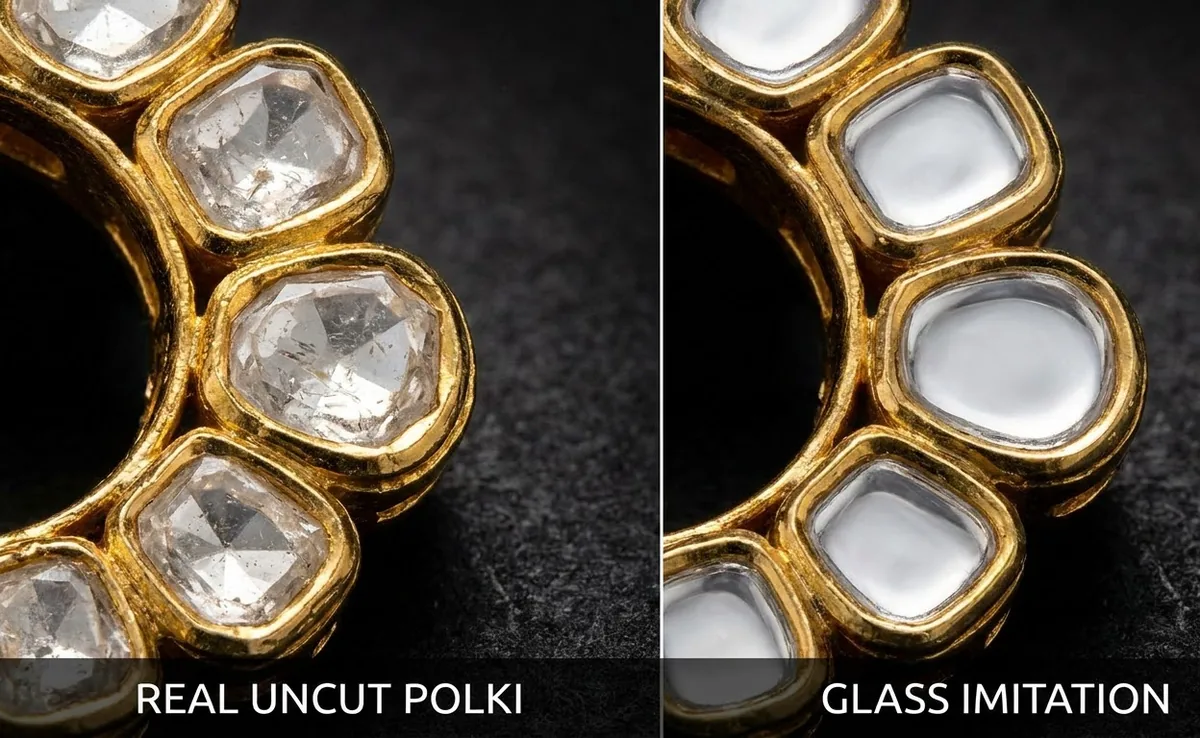
What an imitation jadau piece can and cannot copy
It can copy: the look - flat stones framed by gold, the arrangement, the colours, the pearl drops. In imitation jewellery, glass or synthetic stones are set into a gold-plated frame, usually with jewellery adhesive, to give the same Kundan-style or Polki-style effect.
It cannot copy: the gold itself, the hand-built setting, or the value. An imitation piece is priced for the look, not the metal - and should be sold as imitation, never as jadau gold.
For the look at an imitation price, see getting the Polki look without the Polki price and browse Kundan jhumka earrings.
What is jadau jewellery?
Jadau (also jadau kundan) is a traditional technique of setting stones into gold without prongs or claws. The stones are embedded in a gold setting and then held by layers of pure gold foil (kundan) worked in around each one. It came to India with the Mughals and is closely linked with Rajasthan, especially Bikaner and Jaipur, and with Gujarat.
What is jadau jewellery made of?
In real jadau:
- A gold base, often with meenakari enamel on the back.
- Uncut diamonds (Polki), gemstones or glass.
- Pure gold foil that holds the stones.
- Lac (a natural resin) inside hollow pieces to give them body.
Artificial jadau-style jewellery recreates the look with gold-plated base metal, glass or synthetic stones and foil-style settings.
Why is jadau jewellery so expensive?
Real jadau is expensive because of the gold, the stones and the labour. Each piece passes through several skilled craftspeople - the designer, the enameller, the stone setter and the polisher - and can take weeks. Artificial jadau-style jewellery offers the look at a small fraction of the price, because it replaces the gold and stones and simplifies the process.
Jadau vs Kundan vs Polki
- Kundan - the technique of setting stones with gold foil.
- Jadau - the wider craft of embedding stones in gold, of which Kundan setting is a part.
- Polki - uncut natural diamonds, often set in jadau style.
In everyday shopping, "jadau kundan" and "Polki-style" are often used for the same look. Read Kundan vs Polki.
Jadau jewellery for weddings
Jadau and Kundan-style sets are the classic choice for North Indian, Rajasthani, Gujarati and Hyderabadi brides. A jadau-style choker with a long rani haar, chandbalis and a maang tikka creates a regal bridal look. Read Rajasthani bridal jewellery.
Frequently asked questions
What is the difference between jadau and Kundan?
Jadau is the technique of embedding stones in gold; Kundan refers to the foil and the style that goes with it. In practice the words are used together - "jadau Kundan".
Is jadau available in imitation jewellery?
The look is - Kundan-style and Polki-style imitation pieces reproduce it. The technique itself requires gold.