Meenakari: The Colour on the Back of the Piece
Meenakari is enamel work: coloured glass powder fused onto metal with heat, producing glossy reds, greens, blues and whites that do not fade. It flourished under Mughal patronage. The usual account is that Raja Man Singh of Amber brought enamellers from Lahore to Amer in the late 16th century; the craft moved into Jaipur after the city was founded in 1727, and Jaipur is now its best-known centre. In traditional Kundan jewellery, the meenakari is often on the back of the piece - hidden from view, seen only by the wearer. Here is how it is done, why it sits where it does, and how to tell real enamel from a painted shortcut.
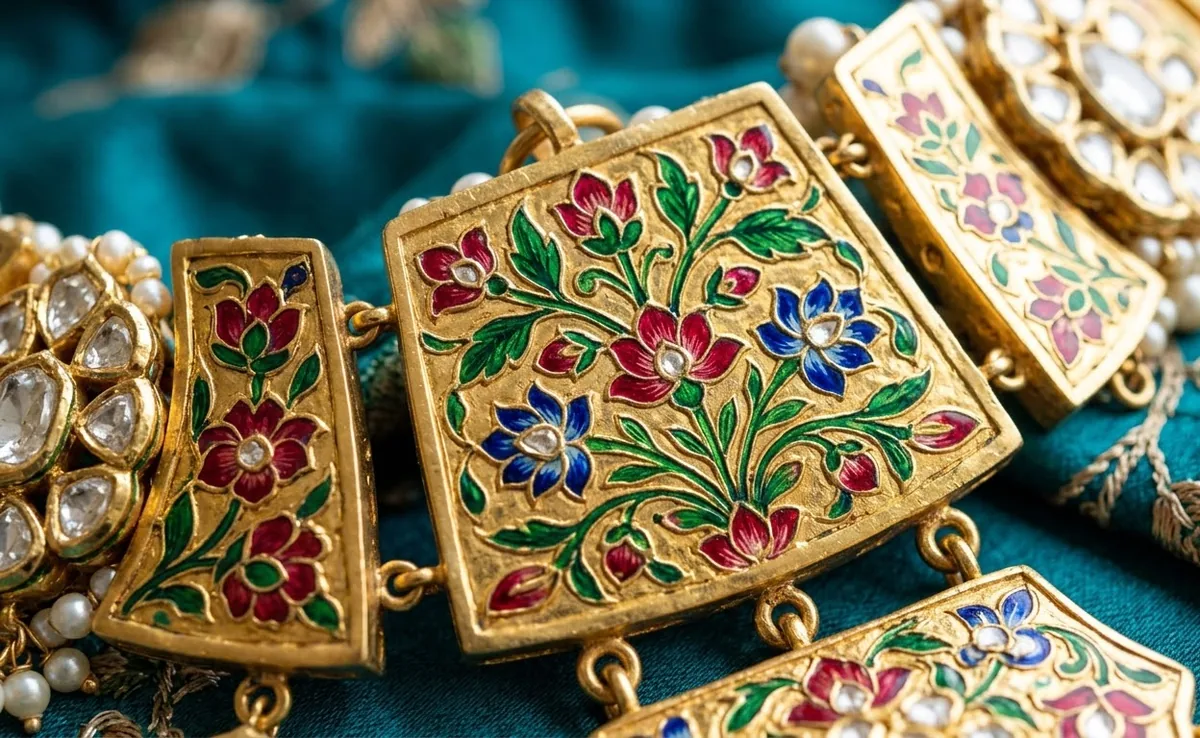
What enamel work is
In true meenakari, the craftsman engraves small hollows into the metal, fills them with finely ground coloured glass mixed with water, and fires the piece so the glass melts and fuses into the hollows. Each colour needs its own firing, usually starting with the colours that tolerate the most heat (white, then blue, green, and finally red). The finished surface is hard, glossy and colour-fast.
Classic meenakari colours are deep red, emerald green, royal blue and white, often around floral and bird motifs.
Why the good stuff is on the reverse
In Kundan jewellery, the front is covered with stones set in gold foil. The back - which touches the skin - is where the enameller works, often with the most detailed patterns in the piece. There are two traditional reasons:
- It shows craftsmanship. A fully enamelled reverse was a sign that the piece was made without shortcuts.
- It was for the wearer. The front is for the world; the back was a private pleasure for the woman wearing it.
Today, many pieces also carry meenakari on the front - on jhumka domes, chandbali crescents and pendant borders - where it adds colour to gold. Read what is Kundan jewellery for the setting on the other side.
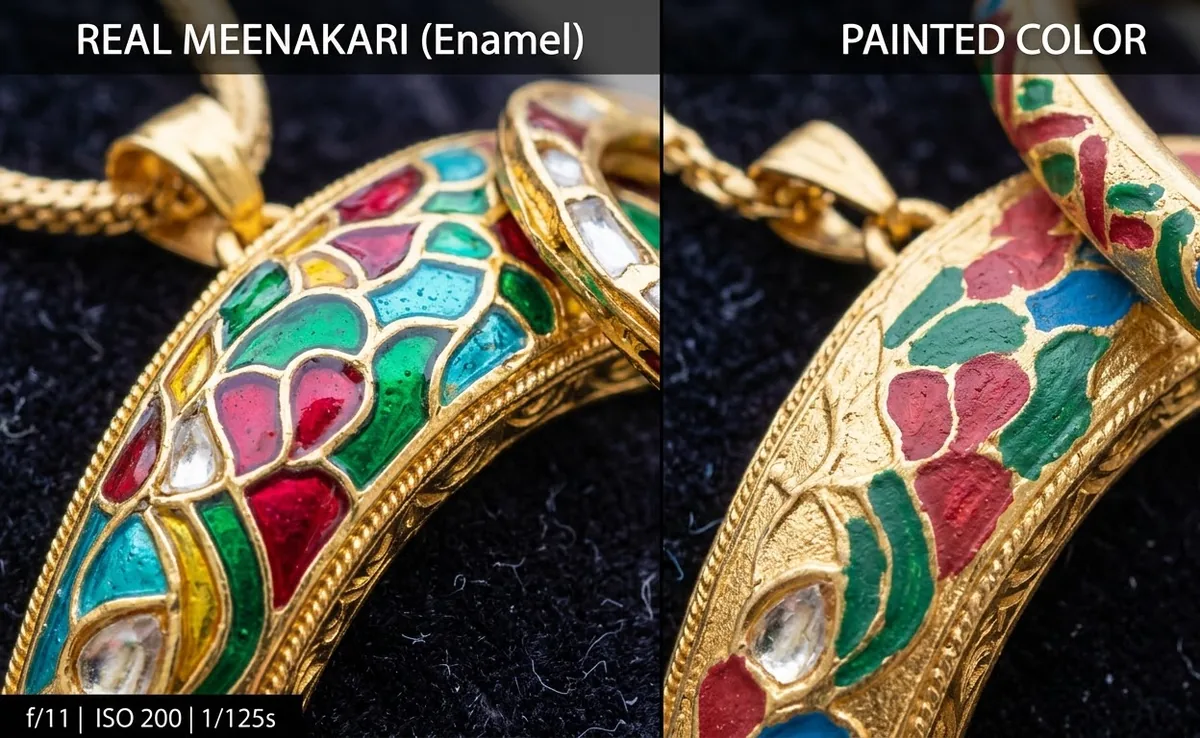
Enamel versus painted colour, and how to tell
Much lower-priced jewellery uses paint or coloured lacquer instead of fired enamel. In photos and in hand:
- Gloss: fired enamel has a deep, glassy shine; paint is flatter and can look plasticky.
- Edges: enamel sits inside engraved hollows with crisp edges; paint often spills slightly over the metal.
- Wear: paint scratches and flakes; enamel can chip if hit hard, but does not rub off.
- Colour depth: enamel reds and greens look like coloured glass because they are.
Both have their place - painted colour keeps prices low. What matters is that a listing tells you which one it is. See enamel or paint for a closer look.
Meenakari is famous in which state?
Meenakari is most famous in Rajasthan, especially Jaipur, which is known for its bright, fired enamel on gold and silver. It is also practised in Varanasi (Uttar Pradesh), known for pink "gulabi meena" - registered as Banaras Gulabi Meenakari, a Geographical Indication, in 2015 - and in Lucknow, Delhi and parts of Gujarat.
Is meenakari and enamel the same?
Meenakari is a type of enamel work. "Enamel" is the general term for coloured glass fused to metal; "meenakari" is the Indian craft tradition of it, with its own designs, colours and techniques. Read meenakari enamel vs paint.
Meenakari jewellery types
- Meenakari jhumkas - colourful domes.
- Meenakari bangles and kadas - enamel on the outer surface.
- Kundan meena sets - Kundan on the front, meenakari on the back.
- Meenakari pendants - peacocks and flowers.
- Meenakari rakhis - popular for Raksha Bandhan.
Is meenakari jewellery expensive?
Fired meenakari on real gold is expensive. Artificial meenakari-style jewellery with cold enamel is affordable and gives the same colourful look for festivals and weddings.
Meenakari with outfits
- Plain saree or kurta: a meenakari jhumka adds colour.
- Bandhani or leheriya: match the enamel colours to the print.
- Bridal red: red and green meena with Kundan.
Browse Kundan earrings.
Frequently asked questions
What is meenakari work?
Enamel work: coloured glass fused onto metal by firing, in hollows engraved into the design.
Does meenakari chip?
Fired enamel is hard but brittle - a sharp knock can chip it. It does not rub off with normal wear.
Which city is famous for meenakari?
Jaipur is the best-known centre; Varanasi and Lucknow also have enamelling traditions.
Browse Kundan chandbali earrings and Kundan jhumka earrings.