What Is Antique Finish Jewellery? How the Look Is Made
Antique finish jewellery looks like old gold that has been worn and loved for generations: darker in the recesses, softly bright on the raised parts, never too shiny. It is the signature look of South Indian temple jewellery, and it is how every piece we sell is finished.
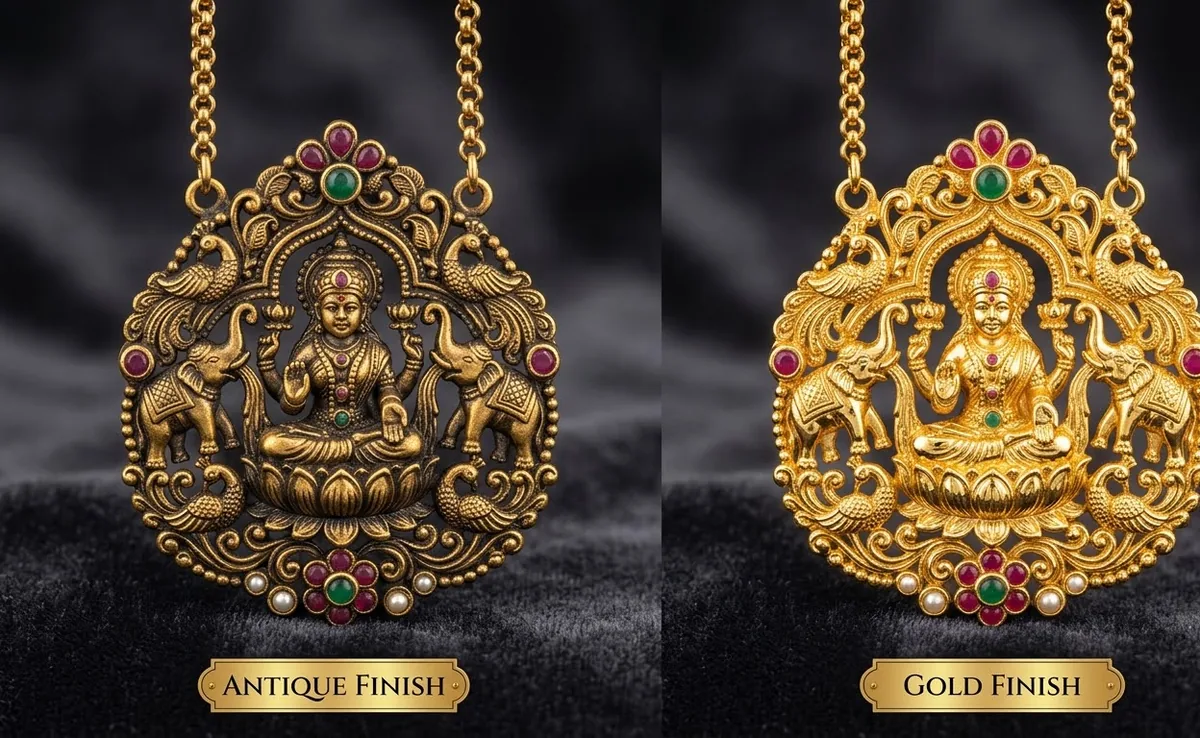
What does antique finish mean?
An antique finish is a deliberately aged look on gold-plated jewellery. Instead of one bright shiny surface, the piece has:
- Dark recesses - the deep parts of the design are darkened.
- Bright highlights - the raised parts are polished back to gold.
- A soft, slightly matte glow instead of a mirror shine.
The contrast makes every detail stand out: the goddess's face, the peacock's feathers, the petals.
How the antique finish is done
In simple terms:
- The piece is cast in the base metal (for us, Zamak).
- It is gold-plated.
- A darkening treatment is applied, which settles into the recesses.
- The raised areas are polished back, revealing the gold.
- Stones are hand-set, and the piece is inspected.
Antique vs matte vs bright gold
- Antique: dark-and-bright contrast; traditional; hides light wear well.
- Matte gold: soft, even, non-shiny gold without dark recesses.
- Bright (polished) gold: mirror shine; modern; shows scratches and wear sooner.
Why antique suits temple jewellery
Temple jewellery is full of carved detail - deities, animals, flowers. The antique finish brings that detail out, and it looks like traditional South Indian gold, which is often worn and slightly dark. Read what temple jewellery is.
Caring for an antique finish
- Do not polish it bright - you will remove the darkening.
- Wipe with a soft dry cloth after wearing.
- Keep away from water, perfume and sweat.
- Store in a pouch so pieces do not rub.
Types of antique finish
- Antique gold - dark recesses, gold highlights. The classic temple look.
- Matte antique - a softer, less contrasted version.
- Red antique (copper antique) - a reddish-brown tone, popular in some bridal jewellery.
- Antique silver / oxidised - dark silver-tone, used for oxidised jewellery.
Why antique jewellery looks "real"
Old gold jewellery naturally darkens in the recesses from years of wear, dust and polishing that only reaches the raised parts. An antique finish recreates that look deliberately. That is why antique gold-plated jewellery often looks more like family gold than bright gold plating does.
Antique finish vs vintage jewellery
- Antique-finish jewellery is new jewellery made to look old.
- Antique jewellery (in the collector's sense) is genuinely old, usually over 100 years.
- Vintage jewellery is generally 20 to 100 years old.
Artificial jewellery described as "antique" almost always means the finish, not the age.
Does the antique finish wear off?
With a lot of polishing, the dark areas can lighten. With normal wear and gentle wiping, it lasts well, and it hides small scratches better than a bright finish. Never use a polishing cloth or cleaner meant for silver or gold on an antique finish.
Antique jewellery for every occasion
- Weddings: temple and antique bridal sets. See temple jewellery sets.
- Festivals: antique jhumkas and coin necklaces.
- Office: a small antique pendant. See antique gold-plated pendants.
How to clean antique finish jewellery
- Wipe with a soft dry cloth after every wear.
- For grime, use a barely damp cloth, then dry at once.
- Use a soft dry brush for the recesses - gently.
- Never soak, never use toothpaste, lemon, vinegar or polishing liquid.
Antique finish with different stones
Antique gold pairs beautifully with ruby-red and emerald-green stones and with pearls. With crystal or AD stones it looks more fusion; that works, but for a classic temple look choose red, green or pearl.
How it behaves in light
- Daylight: antique wins comfortably. Polished metal in strong daylight produces blown-out white patches exactly where the detail is, and a camera cannot recover them.
- Warm indoor light and lamps: antique goes quiet. This is where stones and brighter finishes do more.
- Camera flash: antique holds its shape while polish flares.
If the photographs that matter to you are from a daytime ceremony, antique is the safer buy. Matte or glossy gold works through the full comparison.
Mixing finishes
Within one set, do not. An antique necklace with polished earrings reads as two sets rather than one, and it is the most common reason a good pairing looks subtly wrong in photographs without anyone being able to say why.
Shop this look
- Antique gold South Indian jhumka, scrollwork top - the finish at its most characteristic.
- Antique gold South Indian jhumka, paisley top.
- Lakshmi Arch temple necklace set - cast relief the finish exists to show.
Browse south indian jhumka earrings and temple jewellery sets.
The honest part
Everything here is gold-plated Zamak with hand-set kemp and kundan stones, cast and finished in our family workshop, Jagruti Imitation Jewellery, in Kandivali East, Mumbai. It is imitation jewellery, not solid gold, and the product page says so rather than leaving it to be found out. Free shipping across India, GST in the price, and damage or a manufacturing defect reported within 3 days of delivery is repaired or replaced free, return pickup included.
Frequently asked questions
What is antique finish jewellery?
Gold-plated jewellery with darkened recesses and polished highlights, made to look like old gold.
Is antique jewellery real gold?
Antique-finish artificial jewellery is gold-plated, not solid gold. "Antique" describes the finish.
Why is temple jewellery dark?
Because of the antique finish, which darkens the recesses to bring out the carved detail.
Shop temple jewellery sets.