Assamese Bridal Jewellery: Junbiri, Dugdugi and the Rest
Assamese bridal jewellery has shapes you will not find anywhere else in India: the crescent-moon junbiri, the heart-shaped dugdugi pendant, the broad gamkharu bangle, the jonpata and keru earrings - traditionally in gold with red and green meenakari, worn with a silk mekhela chador. Here are the signature pieces and how to wear them together.
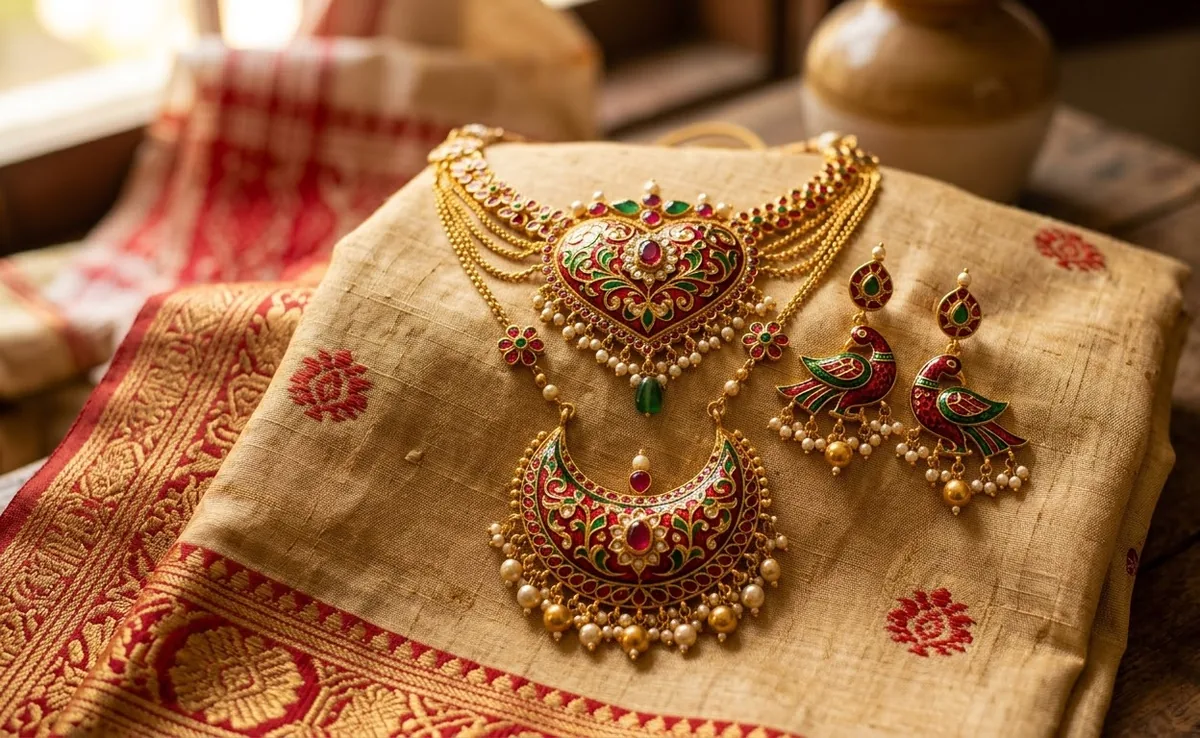
The signature Assamese shapes
- Junbiri - a crescent-moon pendant, usually with small drops along the edge. The most recognisable Assamese piece.
- Dugdugi - a heart- or leaf-shaped pendant, often with a floral pattern.
- Gamkharu - a wide, heavy bangle, traditionally worn in pairs.
- Jonpata - a crescent-shaped ornament, worn by brides.
- Keru - an earring shaped like a ring or a hollow cylinder.
- Lokaparo - a pendant of two birds back to back.
- Golpata - a choker of flat links.
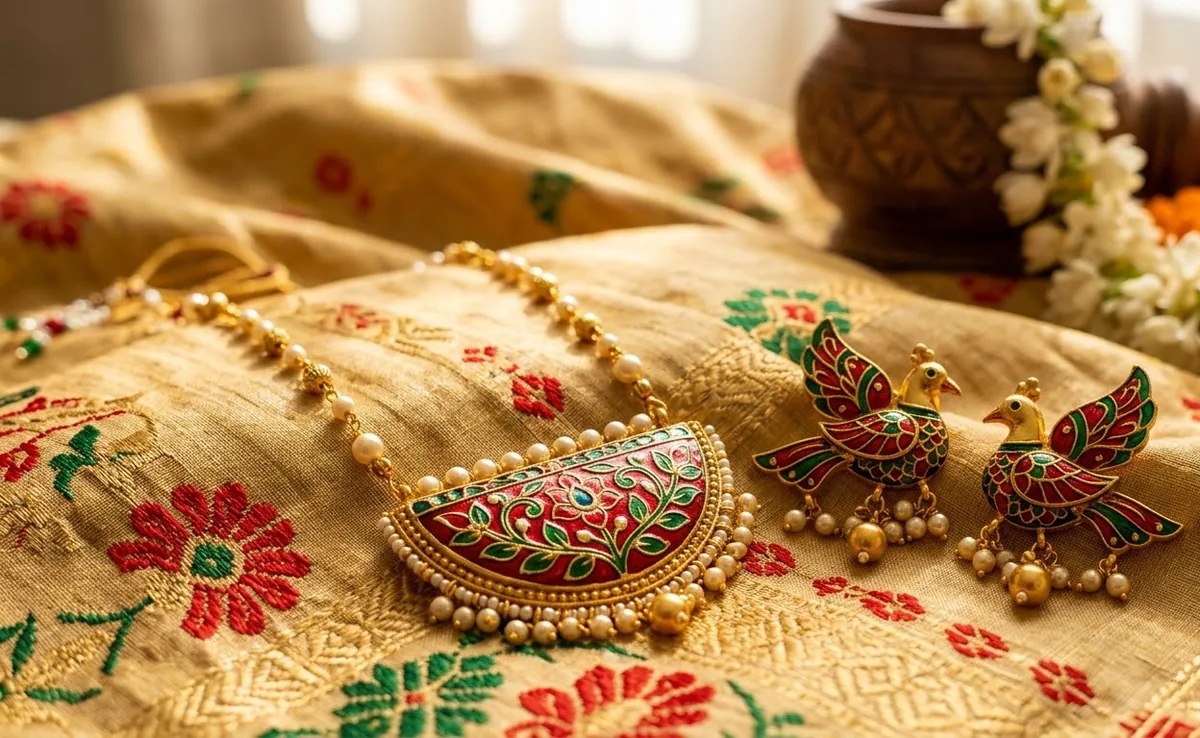
Meenakari in red and green, and why
Traditional Assamese jewellery is often gold with red and green enamel (meenakari) and small red stones. The colours tie the jewellery to the red and gold of a bridal mekhela chador and the green of the region. Read meenakari explained for how enamel work is done.
Matching it to a mekhela chador
A bridal mekhela chador is usually white or cream muga silk with red or gold motifs. Wear:
- One pendant necklace - a junbiri or dugdugi on a bead or gold chain.
- A choker close to the neck for a fuller bridal look.
- Gamkharu or stacked bangles.
- Keru or jhumka-style earrings.
Keep the metal one finish throughout. For gold-plated pendants in stock, see antique gold-plated pendants, and for other East Indian looks, Bengali bride jewellery and Odia bridal jewellery.
Assamese jewellery names
The pieces you will hear about most:
- Jonbiri - a crescent-moon pendant, one of the best-known Assamese designs.
- Dholbiri - a pendant shaped like the dhol drum.
- Gamkharu - a broad, hinged bangle, worn by brides and also by men on stage.
- Keru - an earring worn through the upper ear.
- Thuriya - a stud-style earring with a large decorative face.
- Dugdugi - a heart- or leaf-shaped pendant.
- Lokaparo - a pendant of paired pigeons, symbolising togetherness.
- Galpata - a close-fitting choker.
- Junbiri and bena - more crescent and bird-motif pendants.
What is Assamese jewellery made of?
Traditional Assamese jewellery is made of gold or of silver with gold plating, with red stones or red enamel as the signature colour. Artificial versions use gold-plated base metal with red glass stones or enamel to recreate the look at a lower price.
Assamese jewellery for Bihu
Bihu dancers wear a lighter version of the bridal set: a jonbiri or dugdugi pendant on a black or red bead string, a pair of keru or thuriya earrings and gamkharu on the wrists, with a mekhela chador in muga silk or red and white. A bridal set can be broken up and worn in parts for Bihu.
Choosing an Assamese set online
- Look for the red - the stones or enamel should be a clear, deep red.
- Check the bead strings - many pendants hang on black, red or gold bead strings.
- Ask for sizes - jonbiri and dholbiri pendants vary a lot in size.
Caring for red-stone and enamel pieces
Red enamel and glass stones are the heart of Assamese jewellery. Keep them away from perfume and water, wipe them gently after wearing, and store each piece in its own pouch so the enamel does not chip against other jewellery.
Assamese jewellery beyond weddings
Jonbiri and dugdugi pendants are also worn for Bihu, college festivals and family functions.
Frequently asked questions
What is a junbiri?
A crescent-moon shaped pendant, one of the most traditional Assamese ornaments, often with small drops along its lower edge.
Which jewellery goes with a mekhela chador?
A junbiri or dugdugi pendant, a choker, gamkharu or bangles and keru earrings, in one gold finish.
Can I wear South Indian temple jewellery with a mekhela chador?
A temple pendant can work for a festival, but for a bridal look the Assamese shapes are what the outfit is designed around.